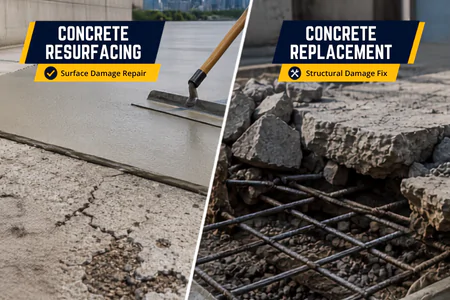
What is the difference between concrete resurfacing and replacement?
Resurfacing means we leave your existing slab in place. We clean it, repair the defects, and bond a new wearing layer of polymer-modified overlay or micro-topping on top. You get a fresh surface, usually a quarter inch to half an inch thick, without touching what sits underneath. Replacement means demolition. We break out the old slab, haul it away, prep and compact the sub-base, set new rebar or mesh, and pour fresh concrete. The distinction matters because most people who call us assume they need replacement when they do not. Concrete that looks terrible on top is often fine underneath. The reverse happens too, though less often: slabs that look passable can hide serious problems.Why concrete fails the way it does in Toronto?
Toronto gets roughly 30 to 40 freeze-thaw cycles a year. Water works into pores and cracks, freezes, expands about nine percent, and pushes the concrete apart from the inside. Repeat that a few dozen times each winter and surfaces start to flake. Then there is road salt. De-icing chloride speeds up surface scaling and, worse, migrates down to the reinforcing steel. When rebar corrodes it expands, and that expansion cracks concrete from within. This is the single biggest reason a slab moves from the resurfacing column into the replacement column. Underground garages, balconies, and exposed walkways across the GTA take the worst of it. We see the same failure pattern on buildings from Etobicoke to Scarborough. It is also why masonry repair and concrete work so often show up on the same building at the same time. The same water is getting into both.When Concrete Resurfacing in Toronto is the right choice
Resurfacing works when damage is cosmetic or shallow. Look for these signs:- Surface scaling and flaking where the top layer is coming off but the slab below is dense and solid
- Hairline cracks under about an eighth of an inch that do not run through the full depth
- A worn or dated finish on a slab that is structurally fine
- Minor spalling where you can see aggregate but no reinforcing steel
- Discolouration, staining, or pitting with no movement in the slab
- Uneven wear on high-traffic areas of an otherwise sound floor
Can you resurface concrete that is already cracked?
Yes, but it depends entirely on the crack. Hairline shrinkage cracks are routine and we route and fill them before the overlay goes down. Cracks that are still moving are a different matter. An overlay bonded over an active crack will telegraph that crack through to the new surface within a season or two, which is why we check whether a crack is dormant before committing to resurfacing.How long does concrete resurfacing last?
A properly installed overlay on a sound slab gives you 10 to 15 years in Toronto conditions. That number drops fast if the prep was rushed, if the slab was not sound to begin with, or if joints around the perimeter were left unsealed and water is getting underneath.When concrete replacement is the only honest answer
We turn down resurfacing jobs regularly. Here is when we would:- Exposed or rusting rebar. Once steel is corroding, an overlay just hides the problem while it keeps growing underneath.
- Structural cracks wider than a quarter inch, especially ones running through the slab or still opening.
- Settlement or heaving. If sections have dropped or lifted, the sub-base has failed. An overlay will not fix a foundation issue.
- A hollow sound when tapped. This means delamination, where the surface has separated from the slab. There is nothing left to bond to.
- Deep spalling over an inch, or spalling across large areas rather than isolated spots.
- Drainage problems where water pools because the slope is wrong. Resurfacing follows existing contours.
- Repeated failed repairs. If a slab has been patched three times, it is telling you something.
Is it cheaper to resurface or replace concrete?
Resurfacing is cheaper up front, generally landing at 40 to 60 percent of replacement cost. But the honest comparison is cost divided by lifespan. An overlay buys you 10 to 15 years. New concrete, correctly placed and cured, gives you 30 or more. Once you run those numbers, resurfacing is the better value when your slab has decades of life left and you are fixing appearance and wear. Replacement is the better value when the slab is near the end of its service life anyway.How do we assess whether a slab can be resurfaced?
An honest evaluation takes more than a walkthrough. Our process:- Visual survey of crack patterns, mapping, scaling, and edge conditions
- Sounding with a chain drag or hammer to find delamination you cannot see
- Core sampling where warranted, to check slab thickness and condition at depth
- Rebar scanning to locate reinforcement and confirm cover depth
- Drainage assessment to check that water moves where it should
- Repair history review, because past patching tells us a lot