If you’ve lived through even one Toronto winter, you already know what the cold does to concrete. One season a step looks fine, the next there’s a crack creeping across it or a corner flaking away. Left alone, that small bit of damage quietly gets bigger, and water finds its way in. The good news is that most of this damage doesn’t mean tearing everything out and starting over. In many cases, a targeted repair fixes the problem for a fraction of the cost.
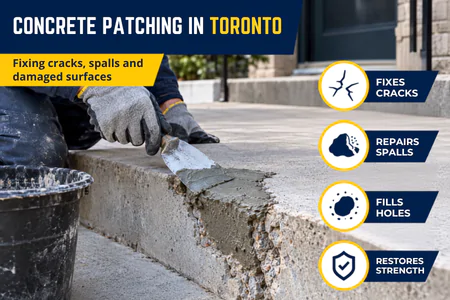
At NHC Building Restoration, concrete patching in Toronto is the targeted repair of cracks, spalls, holes, and surface damage using a bonded repair material, without replacing the entire slab. It’s the right fix for localized damage on structurally sound concrete, usually under 2 inches deep. In our freeze-thaw climate, a properly prepped patch restores strength and stops water damage from spreading.
Below, we walk you through what patching actually fixes, how to tell when it’s the right call, what it costs around the GTA, and how we make sure a patch holds up through another Toronto winter.
What is Concrete Patching?
Concrete patching is the process of filling and bonding damaged areas of a concrete surface so they’re level, sealed, and structurally sound again, without tearing out and re-pouring the whole slab. Picture a crumbling porch step, a pothole in your garage floor, or a flaking patch on a balcony. We remove the damaged material, prep and clean the area, apply a bonding agent, then pack in a repair mortar or patching compound.
Quick Tip: Patching is a repair, not a cover-up. Smearing fresh concrete over a loose, dirty surface guarantees failure within a season. Surface prep is about 80 percent of a lasting patch.
Concrete Patching vs Resurfacing vs replacement
These three get mixed up all the time, so here’s the plain difference:
| Method | What it does | Best for |
|---|---|---|
| Patching | Repairs specific damaged spots | Isolated cracks, holes, spalled areas |
| Resurfacing | Applies a thin new layer over the whole surface | Widespread surface wear, cosmetic renewal |
| Replacement | Removes and re-pours the slab | Deep structural failure, heaved or sunken slabs |
If your concrete has a few bad spots but is otherwise solid, patching is usually the most affordable, sensible route. We break the full comparison down in our guide on concrete resurfacing vs replacement in Toronto.
Why does concrete crack and spall in Toronto?
Our climate is tough on concrete. The main causes we see across the GTA:
- Freeze-thaw cycles: Water seeps into small cracks, freezes, expands, and widens them. Toronto goes through dozens of these cycles each winter.
- De-icing salts: Road and sidewalk salt speeds up surface scaling and corrodes any rebar underneath.
- Poor drainage: Water pooling against or beneath a slab breaks it down from below.
- Age and wear: Traffic, weight, and decades of seasons eventually take a toll.
Did You Know? The City of Toronto uses large amounts of road salt for winter maintenance, and that same salt runoff is one of the biggest reasons residential steps, porches, and garage floors flake and scale near the surface.
When is Concrete Patching the right fix?
Patching is the right call when you’re seeing:
- Hairline to moderate cracks (roughly under 1/4 inch wide)
- Surface spalling or flaking on porches, steps, or balconies
- Small holes or chips in a garage floor
- A crumbling edge or corner on a step
Steps take the worst of it, since they catch foot traffic, water, and salt all at once. If your stairs are the main issue, our guide to concrete step repair in Toronto covers that specific fix in more detail.
Important: Patching is a localized surface repair. If your slab is heaving, sinking, or has wide cracks running across the whole surface, that’s a structural problem. A patch won’t hold, and you may need full concrete repair or restoration instead. When it’s unclear, we inspect before recommending anything.
Signs you should call a pro instead of patching yourself
- The rebar underneath is exposed or rusting
- Cracks keep returning after you fill them
- The damage is on a structural element like a balcony slab or load-bearing step
- Water is passing through to a space below
If it’s on a balcony or elevated slab, don’t take the risk. Here’s what we look for in balcony restoration. And if the damage is on a garage floor specifically, our garage floor repair in Toronto page covers the options in more detail.
How much does Concrete Patching Cost in Toronto?
Cost depends on the size, depth, and location of the damage, plus how easy the area is to access. As a general GTA planning range:
- Small patches (a step corner, a few holes): often a few hundred dollars
- Medium repairs (a porch surface, garage floor sections): mid hundreds to low thousands
- Larger or elevated work (balcony slabs needing rigging or access equipment): higher, due to safety and equipment needs
Quick Tip: Always fix the cause, not just the symptom. Filling a crack without correcting the drainage that caused it means paying for the same repair twice.
We offer free consultations, so you can get a real number for your exact situation before you commit.
How we patch concrete so it lasts
Here’s our step-by-step process:
- Assess the damage and its cause (surface vs structural, drainage, rebar condition)
- Prep by removing all loose, weak, and contaminated concrete back to a sound edge
- Clean thoroughly and apply a bonding agent
- Mix and apply the correct repair material for the load and exposure
- Finish to match the surrounding surface and slope for drainage
- Cure and seal to protect against water and salt
With over 20 years of experience across Toronto and the GTA, we handle everything from a single crumbling step to full building concrete restoration on high-rise and low-rise properties. For the bigger picture on our concrete work, see our concrete repair and restoration guide.