If the mortar between your bricks is cracked, crumbling, or missing, you may be wondering whether you need tuckpointing or repointing. While the terms are sometimes used interchangeably, they technically describe different masonry techniques. Understanding the difference can help Toronto property owners choose the right repair before minor deterioration becomes a larger problem. If you’re considering masonry repair in Toronto or brick repair in Toronto, knowing whether the mortar or the brick itself is failing is an important first step.
Tuckpointing vs. Repointing: What’s the Difference?
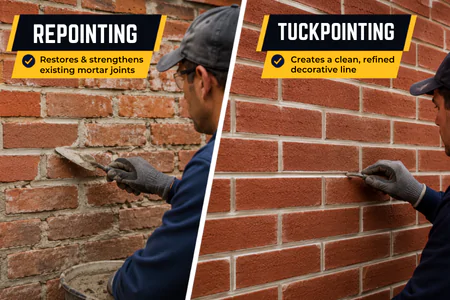
The simplest distinction is that repointing repairs deteriorated mortar joints, while traditional tuckpointing is primarily a decorative masonry technique. Repointing involves removing failed mortar from between bricks and replacing it with compatible new mortar. Traditional tuckpointing uses a contrasting fine line within the joint to create the appearance of narrow, straight and highly defined mortar joints.
The terminology can be confusing because contractors sometimes use “tuckpointing” as a general term for mortar joint repair. For homeowners, the name of the service is therefore less important than understanding the actual work being proposed. Ask whether deteriorated mortar will be removed, how deeply it will be removed, what replacement material will be used and whether it is compatible with the existing
| Feature | Repointing | Traditional Tuckpointing |
| Main purpose | Repair deteriorated mortar | Create a refined decorative appearance |
| Failed mortar removed | Yes | Not necessarily |
| New mortar installed | Yes | Yes, depending on technique |
| Common application | Masonry repair and restoration | Decorative or historic masonry |
| Best for failing joints | Yes | May require repointing first |
For most Toronto properties with visibly deteriorating mortar, repointing is the repair that addresses the underlying problem.
What Is Repointing?
Repointing is the process of carefully removing deteriorated mortar from the joints between bricks and replacing it with new, compatible mortar. Mortar joints are exposed to rain, snow, temperature changes and repeated freeze-thaw cycles. Over time, these conditions can cause mortar to crack, soften, powder or pull away from the surrounding brick.
A professional repointing project typically begins with an inspection to determine the extent and cause of deterioration. Failed mortar is then carefully removed, the joints are cleaned and prepared, and an appropriate replacement mortar is selected. The new mortar is installed and tooled to match the existing joint profile as closely as practical. The objective isn’t simply to improve the appearance of the wall; properly executed repointing helps restore the function of the mortar joints and reduce pathways for moisture to enter the masonry.
What Is Tuckpointing?
Traditional tuckpointing is a more specialized technique historically used to make brickwork appear exceptionally straight and uniform. A contrasting fine line is placed into the mortar joint to create a crisp architectural appearance. It can be appropriate when restoring certain historic buildings or reproducing a particular masonry style.
However, tuckpointing should not be confused with repairing severely deteriorated mortar. If the existing mortar is failing, decorative treatment alone will not address the underlying deterioration. The damaged mortar may need to be removed and replaced before a tuckpointing finish is considered. This is why property owners comparing contractors should focus on the proposed repair method, mortar compatibility and preparation rather than choosing a service based only on the words “tuckpointing” or “repointing.”
How Do You Know Which Repair Your Brick Needs?
The condition of the mortar is one of the biggest clues. Repointing may be appropriate when mortar is crumbling, powdery, cracked, deeply recessed or missing from sections of the wall. Open gaps between bricks, loose mortar and moisture entering through deteriorated joints can also indicate that the masonry needs attention.
Traditional tuckpointing may be considered when the masonry is otherwise suitable for a specific decorative or historic appearance. If the bricks themselves are cracked, broken or severely spalled, however, mortar repair may not be enough. Some walls require both repointing and brick replacement. If you’re unsure which situation applies, our guide to brick repair vs. replacement in Toronto provides a useful comparison of the two approaches.
Signs Your Brickwork Needs Mortar Repair
Homeowners often pay attention to damaged bricks but overlook deterioration in the mortar joints. Take a close look at the spaces between individual bricks, particularly around areas exposed to weather and moisture. Warning signs include:
- Crumbling, sandy or powdery mortar
- Missing sections of mortar
- Cracked or deeply recessed joints
- Small pieces of mortar falling away
- Loose bricks
- Damp or stained masonry
- Recurring moisture problems
- Deterioration around windows, doors or other openings
Not every crack means an entire wall needs repointing. The cause and extent of the deterioration should be assessed first because the problem could involve localized mortar failure, water infiltration, building movement, damaged brick or several issues occurring together.
Why Mortar Matching Matters in Toronto?
Choosing the correct replacement mortar is one of the most important parts of masonry restoration. Older Toronto buildings may have been constructed using softer traditional mortars, including lime-based mortar, so modern mortar isn’t automatically suitable for every older brick wall. An overly hard or incompatible mortar can change how moisture and stresses move through the masonry system and may contribute to deterioration over time.
Toronto’s climate makes material compatibility especially important. Repeated freezing and thawing can put additional stress on masonry, while water entering deteriorated joints can freeze, expand and repeat the cycle as temperatures fluctuate. For this reason, masonry repair in Toronto should take into account the building’s age, existing materials, exposure and construction methods.
Does Damaged Mortar Mean You Need Brick Replacement?
Not necessarily. If the brick units remain sound but the mortar joints have deteriorated, repointing may be sufficient. Brick replacement becomes more appropriate when individual bricks are severely cracked, spalled, broken, loose, displaced or too deteriorated to repair effectively.
Some masonry projects require both services. For example, a facade may have widespread mortar deterioration requiring repointing while several individual bricks have suffered frost or impact damage and need replacement. An inspection helps determine which materials can be preserved and which need to be repaired or replaced.
What About Older and Heritage Brick Buildings?
Older Toronto properties can require a more careful restoration approach because their original materials and construction methods may differ significantly from modern masonry. In many cases, the goal is to preserve as much original material as practical rather than replacing sound historic brickwork unnecessarily.
Depending on the building, restoration may involve matching existing brick, identifying compatible mortar, using appropriate lime mortar, reproducing the existing joint profile and carefully removing only deteriorated material. These considerations can be particularly important in older Toronto neighbourhoods such as the Annex, Cabbagetown and Rosedale. For more information, see our guide to older brick home masonry restoration in Toronto.
How Much Does Masonry Repair Cost in Toronto?
There isn’t one fixed price for masonry repair because the scope can vary considerably from one property to another. Costs may depend on the amount of deteriorated mortar, size and height of the building, accessibility, scaffolding or swing-stage requirements, brick replacement, mortar matching, heritage considerations, moisture damage and the overall condition of the facade.
A small residential mortar repair may be relatively straightforward, while a multi-storey commercial facade restoration can require specialized access equipment, extensive preparation and coordination with engineers or building management. For an accurate estimate, the masonry should be inspected and the required scope of work clearly defined.
When Should You Call a Mason?
Don’t wait until bricks begin falling from a wall before investigating masonry deterioration. Consider arranging a professional assessment if you notice crumbling or missing mortar, loose or damaged bricks, increasing cracks, water staining, spalling, recurring moisture problems or deterioration around windows and other openings.
Early assessment can help determine whether a localized repair is possible or whether the property requires a broader restoration approach. It can also help identify moisture or construction issues that may continue damaging the masonry if left unresolved.