Most condo owners in Toronto don’t think twice about their balcony until something looks wrong. A rust stain shows up under the slab, a railing starts to wobble, or a notice from management announces a restoration project. At NHC Building Restoration, Condo Balcony Repair in Toronto is a big part of what we do. After more than 20 years restoring high rise and low rise buildings across the GTA, we hear the same questions on almost every job.
One thing surprises a lot of owners: your balcony usually isn’t part of your unit. The Condominium Authority of Ontario explains that some shared parts of a condo property, like a balcony, may be set aside for one owner’s exclusive use. These are called exclusive use common elements. Only you can use the balcony, but it still belongs to the condo corporation.
That detail decides who pays when repairs are needed. In most buildings, the condo corporation pays for structural balcony repairs from the reserve fund, while owners handle routine upkeep. Your condo’s declaration sets the final split, so it’s always worth checking. Below, we cover the warning signs, which ones are urgent, who’s responsible, and what to expect during a project.
6 warning signs your condo balcony needs repair
Most balcony problems give you plenty of warning. These are the six we see most often on GTA buildings:
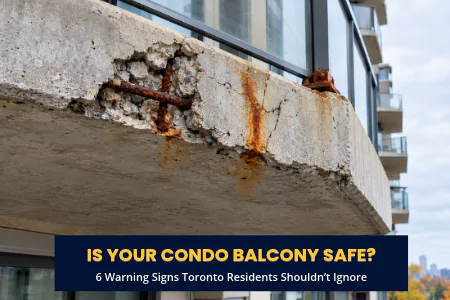
- Spalling concrete: Flakes or chunks break away from the edges or the underside of the slab.
- Exposed or rusting rebar: You see orange rust stains or visible steel in the concrete.
- Cracks in the balcony slab: Cracks where the balcony meets the building wall are the most concerning.
- Loose or corroded guardrails: Railings wobble, or the posts are rusting at the base.
- Ponding water or leaks below: Water pooling on the surface or dripping onto the balcony below usually means the balcony waterproofing membrane has failed.
- A hollow sound when tapped: This points to delamination, where the concrete has separated internally.
Did You Know? Toronto’s freeze thaw cycles and road salt carried outside on boots push chlorides into concrete. The steel rebar inside then rusts and expands, and that expansion cracks the concrete from within. This is called chloride damage, and it’s the root cause behind most of the spalling we repair.
Which balcony warning signs are urgent?
Not every crack means your balcony is unsafe, but some signs need action the same day. Here’s how we’d prioritize what you see:
| What you notice | How urgent | What to do |
| Concrete pieces falling or hanging loose | Urgent | Stop using the balcony, keep the area below clear, and report it in writing the same day |
| Railing moves when you push on it | Urgent | Don’t lean on it, keep children away, and report it immediately |
| Exposed or rusting rebar | Soon | Photograph it and ask management to have an engineer review it |
| Wide cracks near the building wall | Soon | Photograph it, note the date, and report it |
| Water pooling or leaking below | Plan ahead | Report it so the waterproofing can be assessed |
| Hairline cracks or worn coating | Monitor | Mention it at the next building inspection |
Only an engineer can confirm whether a balcony is safe to use. When in doubt, report it and stay off the balcony until it has been checked.
Who is responsible for balcony repairs in a condo in Ontario?
Under Ontario’s Condominium Act, 1998, the condo corporation generally repairs common elements after damage, and owners maintain their own units. However, the Act allows a declaration to make owners responsible for repairing, after damage, the common elements they have exclusive use of. In a 2020 decision, the Ontario Court of Appeal held owners responsible for repairing their exclusive use chimneys because of the condo’s declaration and the Act. The same reasoning can apply to balconies.
In the buildings we work on, the corporation usually covers the big structural work, like slab repairs and guardrail replacement, through the reserve fund. Owners are typically expected to keep drains clear and the surface clean.
Owners can also end up paying when they’ve caused the damage, for example by drilling anchors into the slab or installing flooring without approval. If you’ve added tiles or decking to your balcony, you may need to remove them before the work starts, and reinstalling them is often at your own cost.
Quick Tip: Ask your property manager for two documents: the declaration and the latest reserve fund study. Together, they show who is responsible for the work and whether the money has been planned for. This article is general information, not legal advice.
How often do condo balconies need to be restored?
Ontario condos plan for balcony work through their reserve fund studies. A corporation must complete a comprehensive Class 1 study within its first year, then alternate between Class 2 and Class 3 updates at least every three years, according to the Condominium Authority of Ontario. These studies are often where balcony problems first get flagged.
In our experience, many GTA towers built between the 1970s and the 1990s need their first major balcony restoration somewhere around the 25 to 40 year mark. Protective coatings need attention much more often. Catching problems at the coating stage usually costs far less than full concrete repair later.
What to expect during a Condo Balcony Repair project
For residents and boards, a balcony project usually unfolds in four stages:
- Assessment: An engineer reviews the balconies and prepares a repair plan. Our guide to structural restoration in Toronto explains how this stage works.
- Notice: Management shares a schedule, and residents clear their balconies of furniture, plants, and storage.
- Work on your section: Crews reach the balconies from outside using swing stage rigging, so they rarely need to enter your unit.
- Final review: The engineer checks the completed repairs before balconies reopen.
At 3650 Kingston Rd in Scarborough, we waterproofed the balcony surfaces as part of a larger envelope project that also included concrete repair, window sealant replacement, and new metal cladding. If you’d like the technical details of how we inspect, repair, and waterproof balconies, see our balcony restoration in Toronto page.
How long does balcony restoration take?
Most individual balconies are out of service for a few weeks. A full building project can run across one or more construction seasons, depending on the number of balconies and how far the damage has spread.
Can you use your balcony during restoration?
Not while your section is being worked on. Most residents stay home throughout the project, though you can expect some noise during the concrete removal phase. We coordinate closely with property management, so you’ll know when your balcony is closed and when you can use it again.
Balcony repair across Toronto and the GTA
We work on condo and rental buildings in North York, Etobicoke, Mississauga, Markham, Vaughan, Brampton, Oakville, and Richmond Hill. A board searching for balcony repair in North York and a property manager comparing quotes for balcony repair in Mississauga usually face the same issues: aging slabs, failed membranes, and tight timelines. Our approach is the same in every city: a careful assessment, clear communication with residents, and repairs built to handle Ontario winters.
What should condo boards ask before hiring a balcony contractor?
Before you sign, ask every contractor these questions:
- Are you licensed, insured, and in good standing with WSIB?
- Is your crew trained and certified for suspended access work?
- Have you worked on projects managed by an engineering consultant?
- What warranty do you provide on concrete and waterproofing work?
- Can we see similar balcony projects you’ve completed in the GTA?
We’re a member of the Toronto Construction Association, and our own crew does all the work, with no subcontractors. We operate scaffolding, boom lifts, swing stages, and bosun chairs; you can see the full list on our access and machinery page.
Worried about your building’s balconies? Let’s take a look
If you’ve spotted spalling, rust stains, or loose railings, an early assessment is the easiest way to keep repairs smaller and residents safe. NHC Building Restoration offers free consultations for condo boards, property managers, and building owners across Toronto and the GTA.
Balcony problems often show up alongside other issues on the same building, so we also offer caulking services for windows and balcony door frames, leakage inspection and removal to trace where water is getting in, building facade repair for damaged concrete and precast exteriors, and masonry repair for cracked brick and failing mortar.
Call us at 647-964-0477 or contact our team to book a site visit. Our team will inspect your balconies, explain what we find in clear terms, and work with your engineer through every stage of the repair.