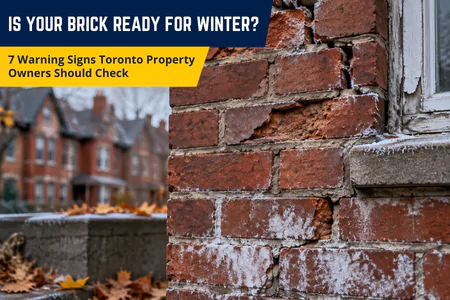
Check your brick walls in October, before the first hard frost. Look for flaking brick faces, crumbling mortar, stair step cracks, white salt stains, loose bricks, damp interior walls and failed sealant around windows. Each one lets water into the wall. Trapped water expands when it freezes, so small autumn defects become costly spring repairs.
At NHC Building Restoration, we get the same call every March. “The brick looked fine last year. Now chunks are falling off.” The damage didn’t happen overnight. It started as a hairline crack or a soft mortar joint that took on water all winter.
The good news is that October gives you a window to catch these problems while the weather still allows proper repairs. Here is what our team looks for when we walk a building before winter, and what you can check yourself this weekend.
Why does October matter for Toronto brick?
Most winter damage to brick comes from freeze thaw cycles. Water soaks into brick or mortar through small cracks and worn joints. When the temperature drops, that water freezes and expands, pushing the material apart from the inside. When it thaws, more water gets in, and the cycle starts again. After enough winters, brick faces start to pop off, which is called spalling, and mortar slowly turns to sand.
That’s why the condition of your walls in October matters so much. Every crack and soft joint you fix now is one less entry point for water before the first hard freeze.
Toronto masonry deals with water, wind and repeated freezing every winter, and the climate is shifting. A CSA Group report prepared by York University identified changing freeze thaw cycles as one of the biggest climate risks for masonry, along with corrosion of the metal ties inside walls. The report also noted that this kind of damage shows up more often in older, historic brick. That is exactly what we see in neighbourhoods like Cabbagetown, Rosedale and the Annex.
💡 Did you know?
Water expands by roughly 9% when it freezes. Inside a saturated brick or a cracked mortar joint, that small expansion creates enough pressure to split the material from within, a little more with every cycle.
What are the 7 warning signs to check before winter?
1. Spalling or flaking brick faces
The outer face of the brick is peeling away or crumbling. This means water is already trapped behind the surface. One spalled brick usually points to a moisture problem nearby. Look closely at areas that stay wet longest, such as under leaky eavestroughs, around downspouts and near the ground where snow piles up. Spalling often starts small, but once the hard outer face is gone, the softer inner brick absorbs water even faster and breaks down quickly.
2. Soft, sandy or missing mortar joints
Run a key along a joint. If mortar scrapes out easily, the joint is no longer sealing the wall. This is usually a repointing job. Our guide on tuckpointing vs repointing in Toronto explains the difference. Mortar is designed to wear out before the brick does, so some wear after a few decades is normal. The problem starts when gaps open deep enough to let rain sit inside the wall instead of running off it.
3. Stair step cracks
Cracks that zigzag through mortar joints can mean settlement or movement. Hairline cracks may be cosmetic. Wide or growing cracks need a professional look before winter widens them. A simple way to track a crack is to mark both ends with a pencil and note the date. If it grows past your marks over a few weeks, the wall is still moving and needs attention.
4. White powder or stains (efflorescence)
White streaks are salts carried out by water moving through the wall. The stain itself is harmless. The water behind it is not. Some light efflorescence is common on new brick and fades on its own. If it keeps coming back in the same spot, it usually points to a steady water source such as a leaking cap, a failed flashing or a downspout soaking the wall.
5. Loose or shifting bricks
If a brick moves when you press it, the bond has failed. Around parapets and chimneys this becomes a safety issue, not just a maintenance one. Loose brick at height can fall onto walkways, especially when ice forms in the joints and pushes units outward. On older buildings, bulging or loose sections can also mean the metal ties holding the brick to the structure have corroded.
6. Damp patches or peeling paint inside
Interior stains on exterior walls often trace back to the masonry. Our post on hidden winter leaks in the GTA covers how to tell where the water is coming from. Water can travel inside a wall before it shows up, so the stain is not always directly behind the damage outside. Musty smells, bubbling plaster and stains that get worse after heavy rain are all signs worth checking before freezing weather arrives.
7. Cracked sealant around windows and joints
Brick often gets blamed for water that actually comes in through failed sealant at windows, doors and control joints. At NHC Building Restoration, our caulking services often go hand in hand with masonry work for this reason. Exterior sealant usually lasts several years, and less if it faces strong sun and wind. Press the sealant with your finger. If it feels hard, has pulled away from the edges or has visible gaps, it is no longer keeping water out.
How urgent is each warning sign?
Not every sign needs the same response. Use this quick guide to see what each one usually means and which ones to deal with before the first freeze.
| Sign | What it usually means | Fix before winter? |
| Spalling brick | Trapped moisture, freeze damage | Yes, if spreading |
| Sandy mortar | Joints no longer shedding water | Yes |
| Stair step cracks | Movement or settlement | Inspect now |
| Efflorescence | Water moving through the wall | Find the source |
| Loose bricks | Bond failure | Yes, safety risk |
| Interior damp | Active water entry | Yes |
| Failed sealant | Easy water path | Yes, quick fix |
If you spotted any sign marked “Yes” in your own walls, it’s worth acting this fall rather than waiting for spring.
Which repairs can wait until spring?
Not everything needs to happen this month. Cosmetic cleaning, colour matching on sound walls, and minor efflorescence can usually wait. Anything that lets water into the wall should not wait.
⚠️ Important:
Mortar needs time and temperature to cure properly. Repointing done in near freezing weather without protection can fail within one season. Book exterior masonry repairs early in the fall, while temperatures still allow good curing.
If you’re unsure whether a damaged brick can be repaired or should be replaced, our brick repair vs replacement guide walks through the decision.
Do you need a permit for masonry work in Toronto?
Most likely repointing and brick replacement doesn’t need a building permit, which keeps many Masonry Repair Toronto jobs simple to schedule. Larger work can change that. The City of Toronto requires a building permit under the Building Code Act for new construction, demolition, additions, or material alteration of a building. Rebuilding a wall section or a chimney can fall into that category. You can check your project on the City of Toronto building permit page.
Heritage properties have extra rules. Designated homes may need approval under the Ontario Heritage Act before any masonry work begins. Grants are also available. The Toronto Heritage Grant Program asks for three estimates from qualified tradespeople. Each estimate should describe the existing condition, the cause of failure, and how much of each wall needs repointing. For older and designated buildings, proper Masonry Restoration Toronto work means using compatible lime mortar and matched brick rather than modern shortcuts that can trap moisture.
✅ Quick tip:
Ask any contractor to put the cause of failure in writing, not just the repair. If a quote says “repoint wall” without explaining why the mortar failed, the problem may come back.
How does NHC Building Restoration handle fall masonry work?
When we take on Masonry Repair Toronto projects in the fall, we follow the same order every time:
- Diagnose first. We trace water entry, settlement or bad past repairs before quoting.
- Prioritize by risk. Safety issues and water entry points come first. Cosmetic work moves to spring.
- Match materials. For heritage buildings, we use lime mortar and matched brick, and we test samples on site.
- Protect the work. We schedule curing time and use weather protection on cooler days.
- Document everything. You get photos and a written scope, which matters for condo boards and grant applications.
At 30 Carabob in Toronto, the NHC Building Restoration team combined masonry, concrete and caulking repairs and stabilized the walls with Helifix brick ties. On taller buildings, our swing stage rigging crew gives us safe access to every elevation. To see everything we cover, visit our masonry repair Toronto service page.
Can you check your own walls in 15 minutes?
Yes. Here is a simple walkaround you can do before the first frost:
- Walk each side of the building in daylight after a dry day.
- Look up at the parapets, chimney and the brick just below the roofline.
- Scrape a few mortar joints at shoulder height with a key.
- Check window and door perimeters for gaps in the sealant.
- Look inside for damp corners, bubbling paint or musty smells.
- Take photos so you can compare them next spring.
If you find two or more of the warning signs above, book a professional inspection now rather than waiting until April.
Book your fall masonry check before the frost sets in
Small cracks become big repairs once winter gets into them. NHC Building Restoration has spent more than 20 years on Toronto brick, from Victorian row houses to 30 storey towers. We’ll tell you plainly what needs doing now and what can wait.
Call NHC Building Restoration at 647-964-0477 or request a free consultation. We work Monday to Friday, 7am to 5pm, across Toronto and the GTA.